What to Expect During Your Tandem Parachute Ride
Tandem Skydiving

Key Takeaways
Freefall gets much of the attention, but the parachute ride is a memorable part of your tandem skydive, too. Once the canopy opens, the pace slows, and the rushing wind gives way to a quieter flight where you can talk with your instructor and enjoy the views. At Skydive Palm Beach, that includes a unique perspective of Lake Okeechobee and the surrounding landscape. Depending on conditions and your instructor’s discretion, you may even get to help steer before they take full control for landing. Whether you prefer exciting turns or a peaceful glide, the canopy ride gives you time to soak in your accomplishment.
A tandem skydive has a few different parts: the anticipation, the ride to altitude, freefall, and the parachute descent back to the ground. You hear a lot about freefall, and don’t get us wrong, it’s amazing! But freefall on a tandem skydive lasts about 40 seconds. The canopy ride – everything after the parachute opens – lasts five to seven minutes. It’s the longest part of the jump by a wide margin, and it’s the part most first-time jumpers say they remember most clearly, because it’s the only stretch quiet and slow enough to actually look around. For some people, this is the part that hooks them even more than freefall!
So, what happens after the parachute opens? What does it feel like? How fast is canopy flight? Can you help steer on a tandem skydive? All good questions! From the quiet after opening to the views and the chance to take the toggles, here’s what to expect during your ride back to Earth.

What Happens After the Parachute Opens?
At the planned altitude, your instructor will open the main parachute, slowing you down to 15 to 20 mph from freefall speeds of around 120 mph. You’ll feel the change in speed through your harness. Think of braking in a car, although some openings feel firmer than others. You’ll also move from lying belly-to-earth in freefall into a more upright, seated position in your harness.
Your instructor will check the parachute to make sure it’s flying properly. If there’s a problem, they’re trained to handle it, which may mean releasing the main parachute and opening the reserve. This is called a cutaway, and sometimes students don’t even realize their instructor has made the switch!
Once those checks are complete, it’s time to settle in and enjoy your time under canopy.
Pro Tip: Have you seen videos where it looks like people shoot upward when their parachute opens? That’s an illusion! In those videos, the camera flyer is still falling while the people under the parachute are slowing down.
It’s Quiet Up There
The change from freefall to canopy flight is pretty noticeable. A moment ago, you had wind rushing past you at around 120 mph. Now, you can actually hear your instructor talking to you!
There’s still some wind noise because you’re moving through the air, but you can have a normal conversation. Ask questions, hear your instructor point out landmarks, or tell the camera what you thought of freefall. You might be laughing, taking a deep breath, or still trying to find the words. There’s no rush.
How long does the parachute ride last? About five to seven minutes. You have a few minutes to look around and take it all in.
What You Can Actually See
Now, let’s talk about the view. Unless you’re a skydiver or pilot, you probably don’t get to see the world from this perspective very often. And at Skydive Palm Beach, the scenery is a pretty good reason to slow down and enjoy the ride.
Our dropzone sits on the shore of Lake Okeechobee, the second-largest freshwater lake entirely within the lower 48 states. We’re talking about approximately 730 square miles of open water stretching out beside you while you fly. Seeing it from the ground is one thing. Taking it in with your feet dangling thousands of feet above the landscape? That’s a whole different experience.
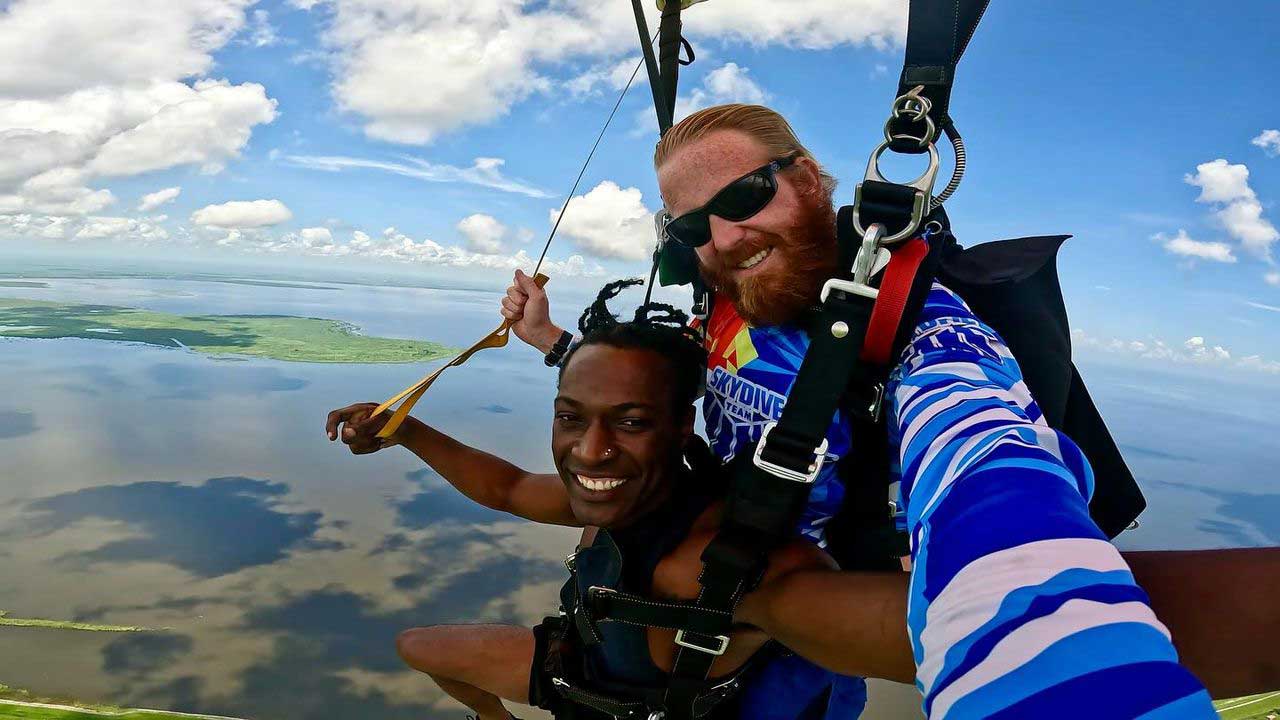
Look inland and the view changes from open water to the patchwork of fields and canals in the Everglades Agricultural Area, with the Everglades farther to the south. You can follow the shoreline toward Pahokee Marina, spot the runway below, and watch the details come into focus as you descend. Your instructor may point out a few landmarks, but give yourself a moment to simply enjoy the perspective, too.
And then there’s the sky itself. Sunlight catching the edges of scattered clouds, shadows moving across the fields, and that wide-open feeling all around you. These are the moments skydivers keep coming back for, even after hundreds or thousands of jumps.
Freefall might have brought you here, but this view could be what makes you want to go again.
Can You Steer the Parachute?
You might get to! We fly modern ram-air parachutes, which are maneuverable wings that we can steer toward our landing area. Your instructor controls the canopy using steering handles called toggles, and they may invite you to help.
That decision is up to your instructor and will depend on the conditions and how you’re feeling. If you’re interested and they give the OK, they’ll show you where to put your hands and guide you through some turns. Getting to feel the parachute respond is a pretty cool part of the experience.
Want a little more excitement? Let your instructor know. If conditions allow, they may demonstrate some more dynamic turns. Prefer to cruise around and enjoy the scenery? That’s completely fine, too. You’ve already jumped out of an airplane. You don’t have to add spins to make it count!
If you start feeling queasy at any point, speak up. Your instructor can ease off the turns and adjust the ride.
Pro Tip: Keep your eyes on the horizon. Staring straight down at the ground can make motion sickness worse.

How the Landing Sets Up
If you help steer, your instructor will take full control well before landing. They’ll tell you when to let go of the toggles and where to put your hands while they get everything set up for the approach.
We don’t just point at the ground and hope for the best! Skydivers follow an organized landing pattern, typically made up of three parts: downwind, base, and final. Your instructor checks the wind, watches for other parachutes, and plans the approach to the landing area. Most of the time, we land in our usual spot, but the plan can change if conditions call for it.
You have a job here, too. Before the jump, your instructor will explain and practice how to lift your legs for landing. They’ll remind you again in the air, so listen for their instructions and be ready to hold your legs up until they tell you otherwise. Your participation matters right through touchdown!
Why It’s Worth Having on Video
There’s a lot happening during your first skydive, and you might not remember every little detail afterward. Having a video means you get to go back and see those moments again, including your reaction once the parachute opens.
That first laugh, the huge smile, or whatever comes out of your mouth after experiencing freefall for the first time? Priceless. Under canopy, you can actually tell the camera how you feel while you’re still thousands of feet in the air. It’s a moment worth keeping, along with the views and the rest of your jump.
Ready for the Ride?
It’s easy to get excited about freefall, but save a little excitement for the parachute ride, too! There are some incredible moments to soak in between opening and landing, whether you’re helping steer or simply enjoying the view.
Book your tandem skydive with Skydive Palm Beach and come find out which part is your favorite: freefall or the canopy ride. Blue skies!